An order insert is the small printed card that rides along in the box, separate from the packing slip that lists what shipped. The slip is a document; the insert is a marketing decision. Done well, it turns a one-time buyer into a repeat customer for a few cents per order. Done carelessly, it is a bent card at the bottom of the mailer that nobody reads. Specifying one properly is a short sequence of decisions, and taking them in order keeps the program cheap to run and easy to measure.
Decide what the insert is for before you design it
An insert should have one job, and the job dictates everything downstream. The common formats each map to a different goal. A discount offer, often the single most effective insert, drives the second purchase with a credit, a percentage off, or free shipping. A thank-you card or personal note is the simplest and least expensive option and does the most for brand warmth, especially when it uses the customer’s name. A tips-and-tricks or care card reduces support tickets and returns by teaching the customer how to use what they bought. A review or social request converts a happy unboxing into public proof; one skincare brand, Frank Body, is frequently cited as having grown to hundreds of thousands of Instagram followers partly on the back of insert prompts. Product samples cross-sell an adjacent line, and a small unexpected gift buys goodwill through simple reciprocity. Trying to do all of these on one card produces a cluttered insert that accomplishes none of them, so pick the primary goal first and let the second message, if any, be clearly subordinate.
Size the card to the package, not the other way around
The right size is the largest card that still lies flat in your shipment without folding. A card that has to be creased to fit reads as an afterthought, and a card swimming in a big box gets lost. Discount offers are frequently printed at business-card size because it is the most economical format and slips into any mailer. Postcard and five-by-seven formats give a thank-you note room to breathe in a medium box, while a half-sheet or rack card suits a larger carton or a card that has to carry care instructions and a diagram. Start from the interior dimension of your most common mailer or box and work back to a trim size that sits inside it comfortably.
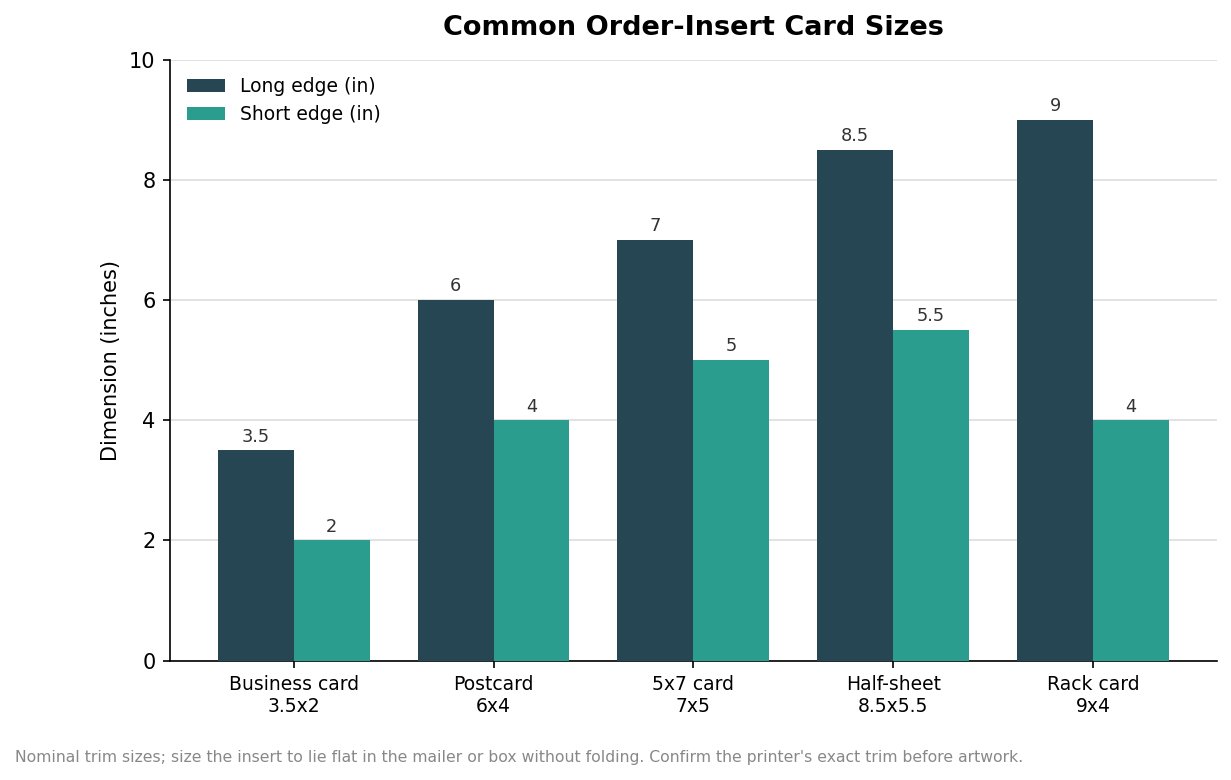
Treat those dimensions as nominal trim sizes and confirm the exact figures with your printer before building artwork, since trim can vary by a sixteenth of an inch and bleed requirements differ between shops. If you ship in more than one box size, it is usually cheaper to standardize on one insert that fits the smallest common package than to run a separate size for each, because the setup and the short-run economics favor a single job.
Choose a stock that matches the message
Weight signals intent. A flimsy insert undercuts a premium product, while heavy card on a disposable coupon wastes money. Lightweight text stocks around 118 to 148 gsm, roughly 80 to 100 pound text, suit a foldable flyer or a care sheet that carries a lot of copy. For a card that should feel substantial in the hand, cover stocks are the norm: a 12-point board lands near 268 gsm, a 14-point near 305 gsm, and a 16-point premium card around 350 gsm. Fourteen-point is the workhorse standard for a card that has to feel like it means something, and sixteen-point is the step up when the brand is positioned as a luxury.
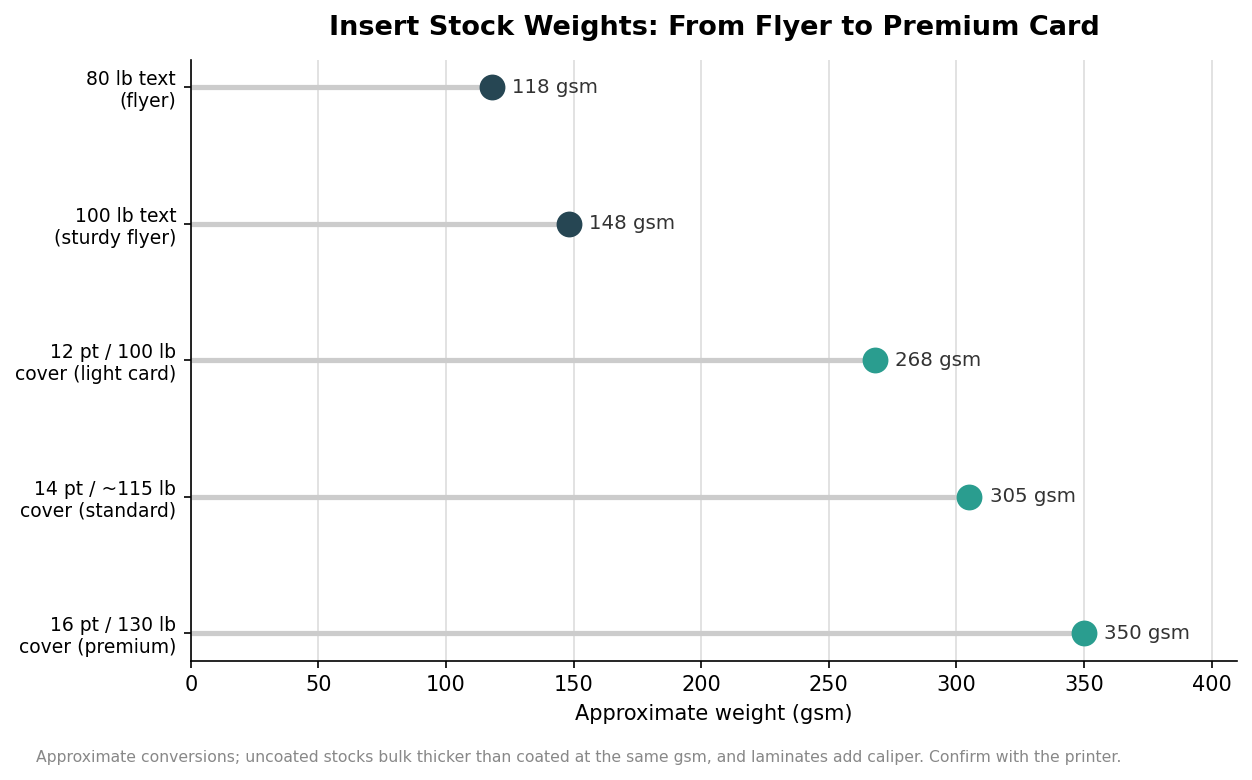
Two cautions keep the stock decision honest. First, these gsm figures are approximations, because an uncoated sheet bulks up thicker than a coated one at the same weight, and a laminate or soft-touch finish adds caliper on top; ask for a physical sample or a drawdown before committing a large run. Second, heavier is not automatically better. A brand that leans into recycled, unbleached kraft aesthetics can communicate more with a lighter uncoated stock than with a glossy heavyweight, so let the material match the story rather than defaulting to the thickest board on the menu.
Static or variable: printing and personalization
The print method follows from whether every card is identical. If the insert is the same for every order, a single static design printed in bulk is by far the cheapest route, and the per-unit cost drops sharply with quantity, which is why a static thank-you card can cost a fraction of a cent at volume. The moment you want the card to change per order, a printed customer name, a unique discount code, a product-specific care tip, you are into variable-data or digital on-demand printing, which costs more per piece but unlocks personalization and per-order tracking. A practical middle path many brands use is a static card design with a single generic code or QR, printed in bulk, which captures most of the benefit at the static price. Decide which of these three you need before you request quotes, because the cost curves are very different and mixing them up leads to sticker shock.
Build in a way to measure it
An insert program you cannot measure is a guess you keep paying for. The cleanest way to know whether the card works is to make its action trackable: a discount code that exists only on the insert, a QR that lands on a dedicated URL, or a review link with its own tag. Redemptions and scans then tell you the real return rather than a vibe. This is also where a return-oriented insert earns its keep, since a meaningful share of shoppers, reported by Statista at around a third, say they want a return label included with the original order, and giving them a clear returns path on the insert can lower the support burden even though it feels counterintuitive to make returning easier. Once one code is running, test a second offer against it, keep the winner, and retire the loser. That single habit, changing one variable at a time and reading the codes, turns the insert from a nice-to-have into a line item that pays for itself.
Leave a Reply