A finished order usually leaves the building with three or four pieces of paper attached to it, and it is easy to treat them as interchangeable. They are not. A packing slip, a commercial invoice, a shipping label, and, on international freight, an export packing list each answer a different question for a different reader. Mixing them up is how a customer ends up seeing wholesale pricing they were never supposed to, or how a pallet sits in a customs queue because the paperwork was thin. This guide walks through what each document is for, what belongs on it, and where the honest overlaps are.
What a packing slip is, and what it deliberately leaves out
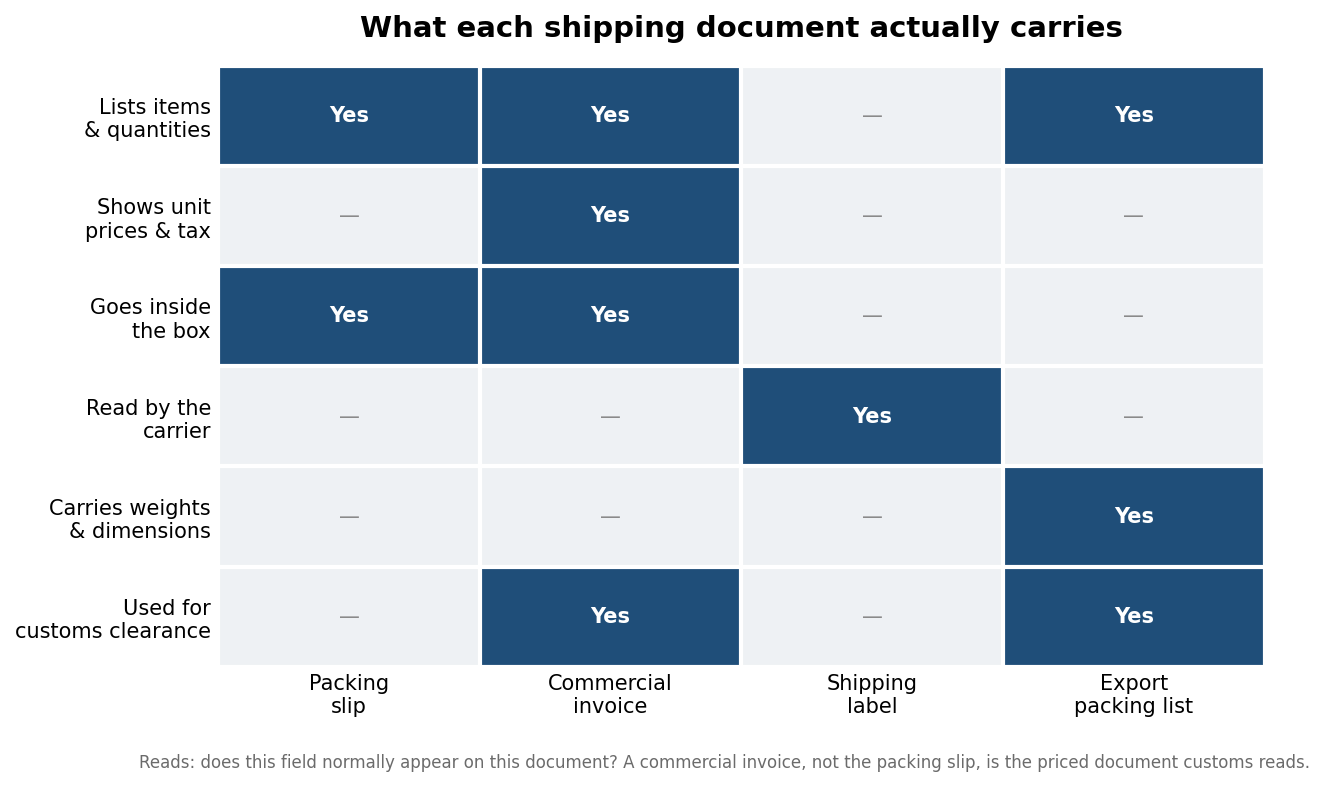
A packing slip is a contents manifest for one specific parcel. Its job is to let two people confirm the same thing: the warehouse picker checking that the box holds what the order called for, and the customer opening it to confirm nothing is missing. To do that it lists the item names, SKUs, and quantities, the order number, and the ship-to and sold-to details. What it does not carry is money. A packing slip normally shows no unit prices, no tax, no subtotal, and no payment terms, and that omission is intentional rather than an oversight.
The pricing exclusion matters most in two situations. The first is drop-shipping and third-party fulfillment, where the person packing the box is not the person who sold the goods, and printing the retail price would hand the end customer your supplier relationship. The second is gifting, where a recipient should not see what the sender paid. Because the packing slip is the one document that reliably travels inside the box, it is also the piece most brands treat as a branding surface, but its core contract is verification, not billing.
Packing slip vs. invoice: the money question
The invoice is the financial twin of the packing slip. Where the slip proves what shipped, the invoice records what is owed. It repeats the item lines but adds unit prices, discounts, tax, a subtotal and total, payment method or terms, and often a company logo and remit-to information. In consumer e-commerce the two frequently look similar because the same order data feeds both, but they are read by different people at different moments: the packing slip by whoever opens the box, the invoice by an accounts-payable clerk or the buyer’s records. For most direct-to-consumer orders the customer has already paid at checkout, so a separate invoice is optional and the packing slip stands in as the human-readable summary. In business-to-business selling, where terms like net 30 are common, the invoice is a distinct and legally meaningful document that should never be reduced to a slip.
A practical test settles most disputes about which is which: if the document is meant to make someone pay, it is an invoice; if it is meant to help someone check a box against an order, it is a packing slip. When a single template tries to do both, it usually does one of them badly.
The shipping label and the bill of lading play a different game
A shipping label is not really a paperwork document at all in the accounting sense; it is a set of routing instructions for the carrier. It carries the destination and return addresses, a tracking barcode, the service level, package weight, and a routing or zone code that the carrier’s scanners read. It says nothing about what is inside beyond weight, and it is emphatically not customer verification. The label answers “where does this go and who moves it,” while the packing slip answers “what is in it.”
On freight, a third document enters: the bill of lading. A bill of lading is a contract of carriage and a receipt issued by the carrier, and it governs the legal relationship between shipper and freight company. It is not a substitute for a packing slip either. A pallet can carry a bill of lading on the outside for the carrier and a packing slip or packing list inside describing the cartons, and each serves its own audience. Treating the label or the bill of lading as “the paperwork” and skipping the contents document is a common way for a receiving dock to sign for a shipment it cannot actually reconcile.
When a full export packing list replaces the slip
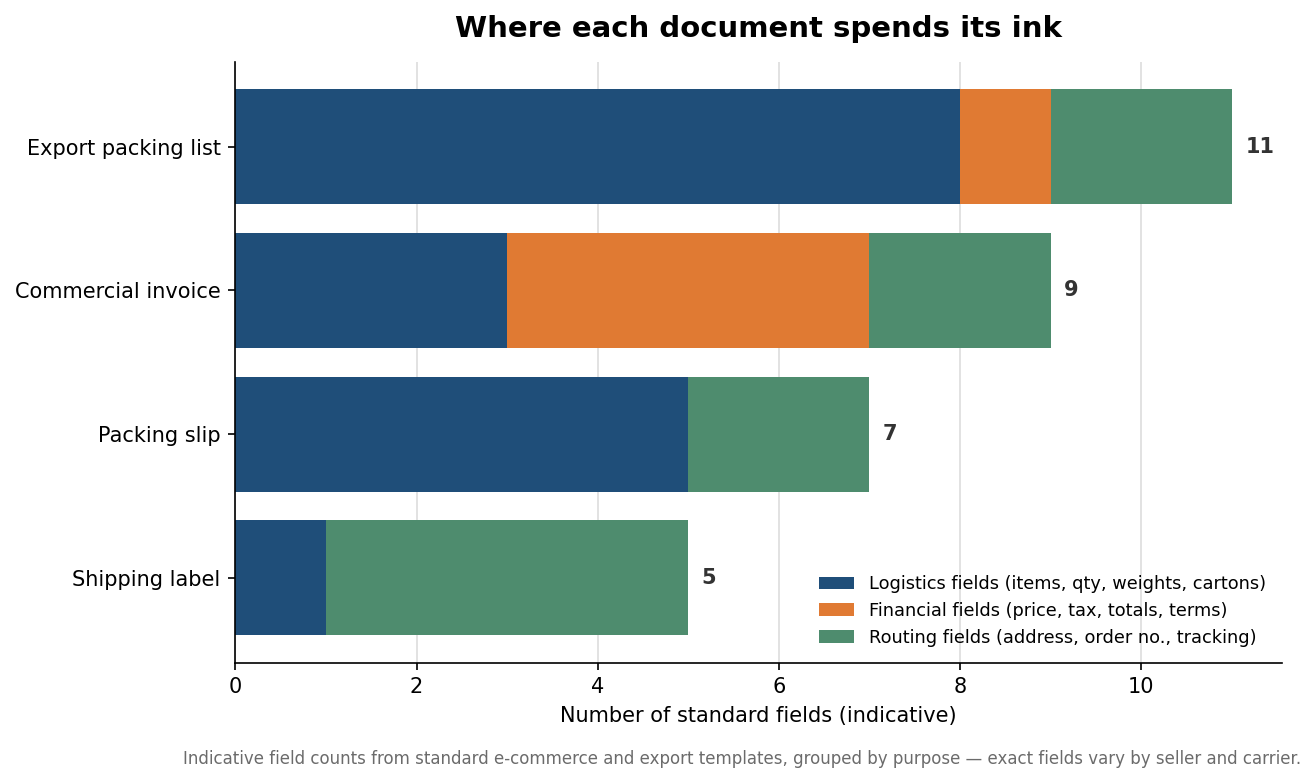
For international shipments the humble packing slip grows up into an export packing list, and the extra detail is not optional decoration. A customs officer needs to reconcile the physical shipment against the paperwork, so an export packing list typically adds gross and net weights, carton dimensions, the number of packages and how items are distributed across them, country of origin, and Harmonized System tariff codes. It travels with the shipment, usually attached externally or bundled with the freight documents rather than tucked inside a single box, and it works alongside the commercial invoice, which supplies the declared values. Thin or mismatched paperwork here has a concrete cost: shipments held for inspection, requests for clarification, and days added to a lead time that was quoted as though clearance were instant.
The distinction between a domestic packing slip and an export packing list is really a distinction of audience. A domestic slip is written for a customer and a warehouse. An export packing list is written for a customs authority and a freight forwarder, and it assumes the reader will physically weigh and measure what it describes.
Getting the fields right before you print
The cheapest time to fix a document problem is before the run, not after a thousand slips are boxed. Decide first who each printed piece is for, then let that reader dictate the fields. If customers will see the packing slip, keep pricing off it and make the item descriptions readable rather than internal codes. If the same order needs a paying invoice, generate it as its own document with the financial fields intact. If anything is crossing a border, plan for an export packing list with weights, dimensions, and tariff codes from the start rather than upgrading a domestic slip at the dock.
None of this requires exotic software. It requires being deliberate about the fact that a shipment usually needs more than one document, and that each one is answering a different question. Get the audiences straight and the fields follow; blur them, and you get the classic failures, a customer who saw a cost they should not have, or a pallet waiting on a form that was never filled in.
Leave a Reply